Articles about Attitudes
December 31, 1990 Rocky Mountain
News
Good attitude critical
to health, institute says
An attitude adjustment is more
important in preventing disease than changes in diet and exercise
habits,
the American Institute for Preventative Medicine says in its New Year's resolutions
list.
The No. 1 entry on the institute's
sixth annual "Top Ten Healthiest Resolutions" list
is to avoid "psycho sclerosis" -- a hardening of the attitudes,
says Dr. Don Powell, president of the Detroit-based institute.
"It's the way we view the
events in life," he said.
"We used to think physical fitness was from the neck down,
but now we see it as more of an integration of mind and body."
Powell, author of 365 Health
Hints,
said working out at the gym isn't enough for people who want to live longer,
healthier lives.
"You have to look at their
attitude, the way they deal with stress,
whether they have a social support network, and the way they view life," he
said.
Adopting the resolutions on the
list, which is based on recent medical research,
could add up to 20 years to a person's life, Powell said.

February, 1996 Rocky Mountain
News
Attitude's everything
in medicine
By Rob Bogin, MD
When a major shift in medical
thinking occurs, it's an exciting and rare occurrence.
We're seeing one now. It's the growing acceptance of the nocebo effect.
You've probably heard of the
placebo effect. It's when a medical condition improves after a "dummy" pill
is taken,
because the patient believes the pill will help.
The nocebo effect is the opposite: Bad things happen when a patient expects
the worst.
More research supports the nocebo
effect as a real finding.
For many years, doctors reported an occasional case involving an individual
patient's response.
These reports are called "anecdotes" and aren't considered very scientific.
But a recent article in the Journal of the American Medical Association
points out the growing number of studies of -- and interest in -- the nocebo
effect.
One controlled study found that
when doctors paid only a brief visit to patients the night before
surgery,
they needed more pain medication and stayed in the hospital longer.
Other patients who had a particularly warm,
and compassionate meeting with the doctor did much better in these categories.
A few years ago, another study
showed that people with depression
were more likely to have heart attacks, and were more likely to die from them,
than those in a good state of mental health.
One very large study of heart
disease compared women
who believed they were likely to have a heart attack to women who didn't.
The remarkable finding: the women who thought they were at risk
were nearly four times more likely to die from heart disease.
Cancer is a prime example of
how powerful the nocebo effect can be.
A group of women with breast cancer was split into two sections.
One sections participated in group therapy.
They talked about dealing with the effects of negative comments from other
people.
The women in the other section didn't participate.
After four years, many more women in the therapy group were alive.
All of these studies really point
to one conclusion.
The mind is one of your most powerful allies -- or enemies -- in a disease.
Nocebo's effectiveness lies in the power of suggestibility.
And that's the secret of defeating it, too.
If you approach an illness with
a determined, positive attitude,
you can decrease pain, feel better and maybe even live longer.
Dr. Bogin is a Denver internal
medicine specialist.
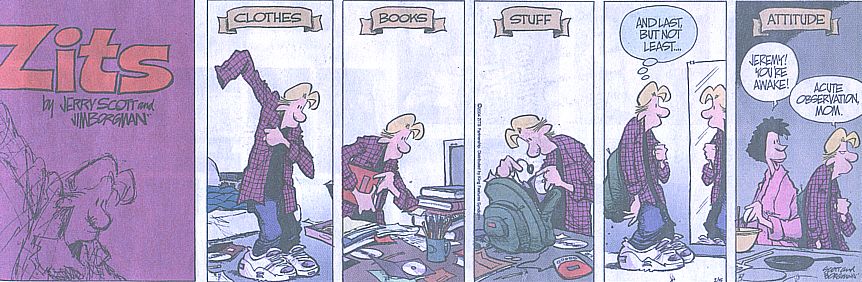
As seen in The Denver Post & Rocky Mountain News
Comics Second Section Sunday, Febbruary 15, 2004
©2004 ZITS Partnership, Distributed by King Features Syndicate
SUCCESS is reached by positive thinking!
by Harvey Mackay "Outswimming the Sharks"
Rocky Mountain News
Saturday, December 17, 2005
In a study at a Big 10 university years ago, they picked
on specific students to prove a point about negative feedback.
During the first hour, someone would say, "Gee Greg, do you feel OK? You
look sick."
Then during the second hour another student would say, "Greg,
you've got bags under your eyes. Didn't you sleep last night?
During the third hour it would be, "Greg, you look nervous. Are you worried
about something?"
By the fifth hour, Greg is so distraught, he checks himself into the hospital.
That's what negative feedback can do to you.
Maya Angelou, the poet and author, said, "I am
convinced that the negative has power
and if you allow it to perch in your house, in your mind, in your life, it
can take you over."
That's why I don't hang around with negative people.
A negative person brings you down.
A negative person sees the difficulty in every opportunity while a positive
person sees the opportunity in every difficulty.
Dr. Herbert H. Clark, a psychologist from Johns Hopkins
University,
discovered that it takes the average person about 48 percent longer to understand
a sentence using a negative
than it does to understand a positive or affirmative sentence.
Author Norman Vincent Peale wrote a book a few decades
ago which I reread and study every now and then,
titled The Power of Positive Thinking (Ballantine, 1996).
Its a fairly quick read and a little gem I recommend to everyone, along with
the follow-up books he wrote on the same subject.
This is confirmation of something every successful
person knows: The secret of good communication is positive affirmation.
It is not what you can't or won't do that interests people but what you can
or will do.
In many companies there is a person who will say, "I
can do it." There's also likely a person who will say, "It
can't be done.
We've tried it before and it didn't work. We're wasting our time. Why should
we bother?"
You know which one you'd rather be assigned to work with.
And, as important as a positive attitude is, it isn't
too hard to get bogged down in the details.
Before you know it, you've become the person you can't stand to be around.
It takes some work to look on the bright side at times.
But you won't do your best work when you are looking for problems: It's when
you are looking for solutions.
Three men set out on a journey. Each carried two sacks
around his neck -- one in front and one in back.
The first man was asked what was in his sacks."In this one on my back," he
said, " I carry all the kind deeds of my friends.
In that way they are out of sight and out of mind, and I don't have to do anything
about them. They're soon forgotten.
This sack in front carries all the unkind things people do to me. I pause in
my journey every day and take these out to study.
It slows me down, buyt nobody gets away with anything."
The second man said he kept his own good deeds in his
front sack. "I constantly keep them before me," he said,
"I gives me pleasure to take them out and air them."
"The sack on your back seems heavy," someone
remarked to the second traveler. "What is in it?"
"That's where I carry my mistakes," said
the second man. "I always keep them on my back."
The third man was asked that he kept in his sacks. "I
carry my friends' kind deeds in this front sack," he said.
Said an observer, "It looks full. It must be heavy." "No," said
the third man, "it is big, but not heavy.
Far from being a burden, it is like the sails of a ship. It helps me move ahead."
Added the observer, "I notice that the sack behind
you has a little hole in the bottom. It seems empty and of very little
use."
To which the third man replied, "That's were (sic) I put all the negative
comments I hear from others,
It just falls out and is lost, so I have no weight to impede me."
Guess which of the three travelers finished first in
their journey through life?
Mackay's Moral: Negativity makes a persson
look at the land of milk and honey and see only calories and cholesterol.
_________________________________
Harvey Kackay can be reached at Harvey@mackay.com
or by writing him at Mackay Envelope Co., 2100 Elm
St. SE, Minneapolis, MN 55414
Thank you Harvey.


![[Click to Return HOME]](Images/HomeButton.jpg)